
Under Review
LiME: Lightweight Mixture
of Experts
Expert specialization through lightweight modulation vectors and zero-parameter routing for efficient multimodal multi-task learning
Expert specialization through lightweight modulation vectors and zero-parameter routing for efficient multimodal multi-task learning
LiME replaces heavy per-expert parameters with lightweight modulation vectors and a zero-parameter router — enabling efficient expert specialization at a fraction of the cost.
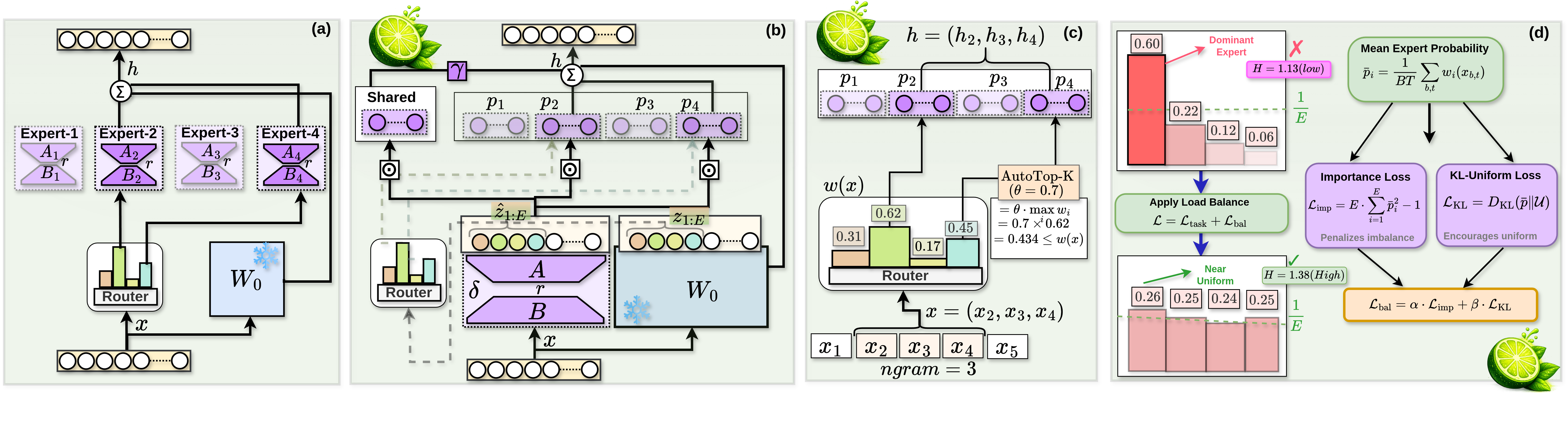
Figure 1. LiME architecture — (a) Standard MoE-LoRA, (b) LiME shared adapter + modulation, (c) AutoTop-K routing, (d) Load balancing losses.
A single shared LoRA adapter modulated by lightweight per-expert vectors — dramatically reducing parameters while preserving specialization.
Expert routing via n-gram hidden-state similarity — no learned gating weights, no auxiliary parameters, no routing collapse.
Dynamically adjusts expert activation per token based on confidence thresholds, enabling adaptive computation.
Importance loss + KL-uniform loss ensures experts are utilized evenly, preventing dominant-expert collapse.
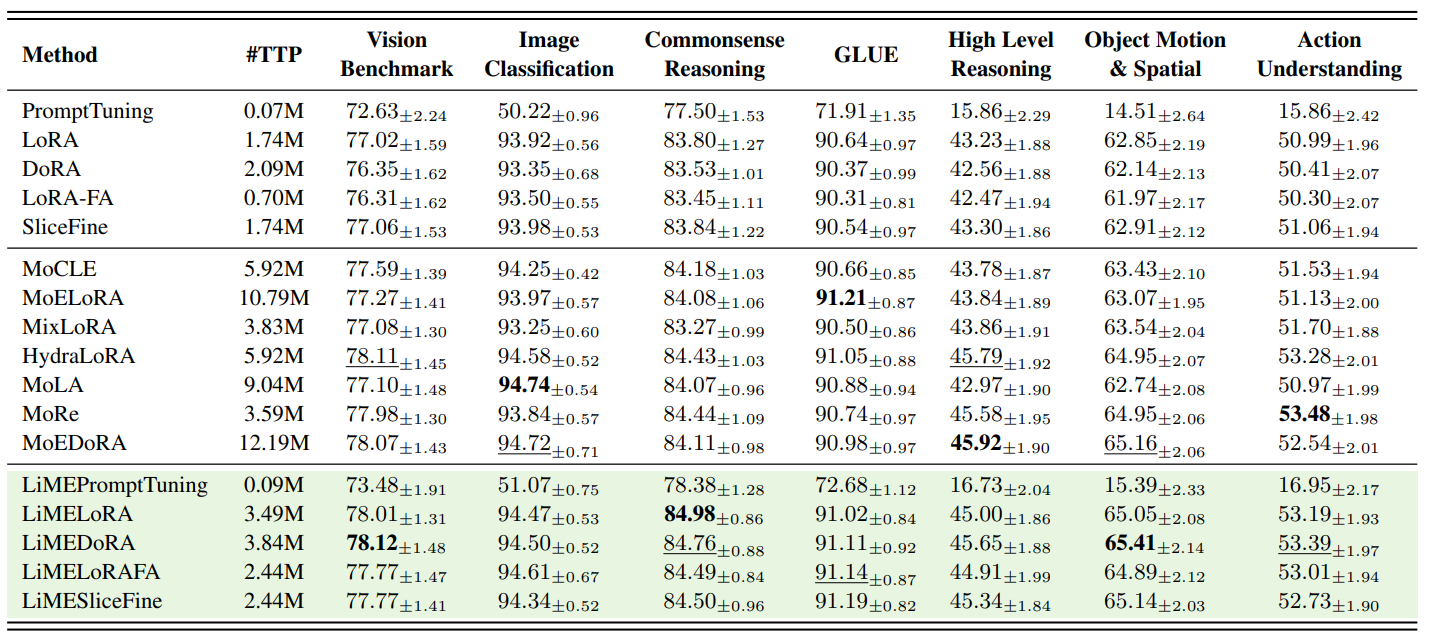
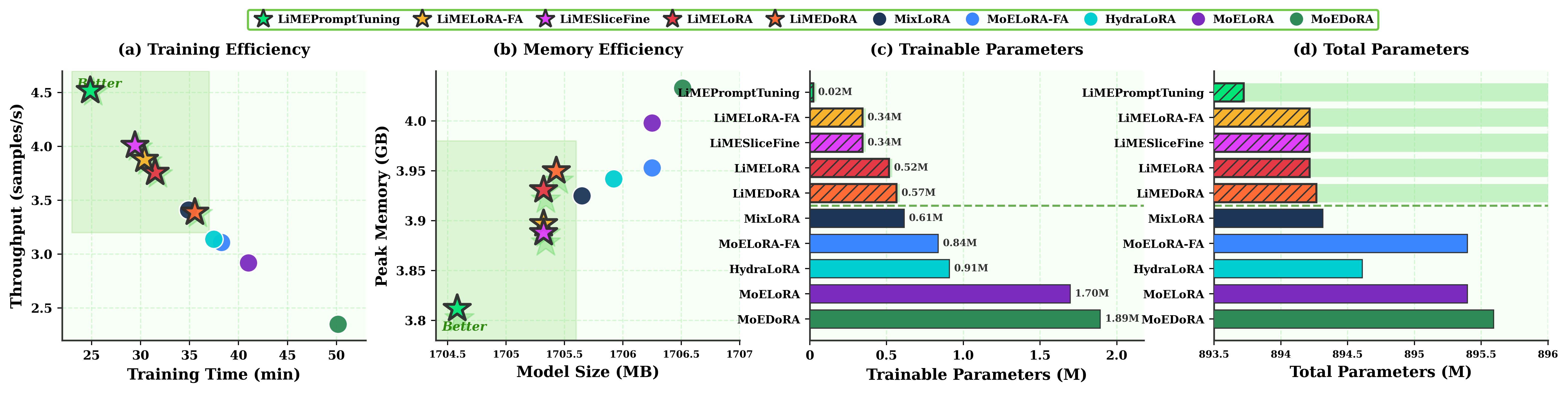
LiME matches or outperforms existing MoE-PEFT methods with up to 4× fewer trainable parameters and higher throughput.
Apply LiME to any pretrained model with just a few lines of code. Compatible with LLaVA-OneVision, Qwen2-VL, and more.
Clone the repository and install required packages.
Wrap any model with LiME using a single function call.
Use our custom trainer with specialized learning rates for MoE and PEFT components.
from LiMELoRA import apply_peft
from transformers import LlavaOnevisionForConditionalGeneration

# Load your base model
model = LlavaOnevisionForConditionalGeneration.from_pretrained(
    "llava-onevision-qwen2-7b-ov-hf",
    torch_dtype=torch.bfloat16,
    device_map="auto",
)

# ⭐ Apply LiME — one line is all you need
model = apply_peft(
    model,
    targets=["q_proj", "k_proj", "v_proj", "o_proj", "out_proj"],
    num_experts=4,
    rank=2,
    use_shared_LiME=True,
    n_gram=1,
    top_k=1,
    rep_mode="token",
    jitter_noise=0.1,
    tokenizer=processor.tokenizer,
    temperature=0.5,
    gamma_routing=0.7,
    auto_topk=True,
    auto_topk_threshold=0.5,
)
from trainer import LiMEArguments, LiMETrainer

training_args = LiMEArguments(
    output_dir="./llava-lime-finetuned",
    per_device_train_batch_size=5,
    gradient_accumulation_steps=4,
    num_train_epochs=4,
    bf16=True,
    learning_rate=2e-4,
    moe_lr=1e-3,          # Dedicated LR for routing components
    peft_lr=4e-4,         # Dedicated LR for LoRA A/B
    importance_coef=0.1,
    kl_coef=0.01,
    balance_every_n_steps=50,
)

trainer = LiMETrainer(
    model=model,
    args=training_args,
    train_dataset=train_dataset,
    tokenizer=processor.tokenizer,
    data_collator=collator,
)

trainer.train()
A comprehensive multimodal multi-task benchmark with 47 tasks spanning vision, language, reasoning, and video understanding.
# Download the HuggingFace dataset
pip install datasets
python -c "from datasets import load_dataset; load_dataset('Kowsher/MMT-47')"

# Download images
huggingface-cli download \
  Kowsher/MMT-47 \
  --repo-type dataset \
  --include "images/*" \
  --local-dir images/

# Extract images (images.zip is a zip file)
cd images && unzip images.zip && cd ..
# Download video data from MVTamperBench
huggingface-cli download \
  Srikant86/MVTamperBench \
  --repo-type dataset \
  --include "video/*" \
  --local-dir videos/

# Extract all video zip files
cd videos/
for f in *.zip; do
  d="${f%.zip}"
  if [ -d "$d" ]; then
    echo "Skipping $f (already extracted)"
  else
    echo "Extracting $f"
    unzip "$f" -d "$d"
  fi
done
cd ..
If you find LiME useful in your research, please consider citing our paper.